- Ruhr-Universität Bochum
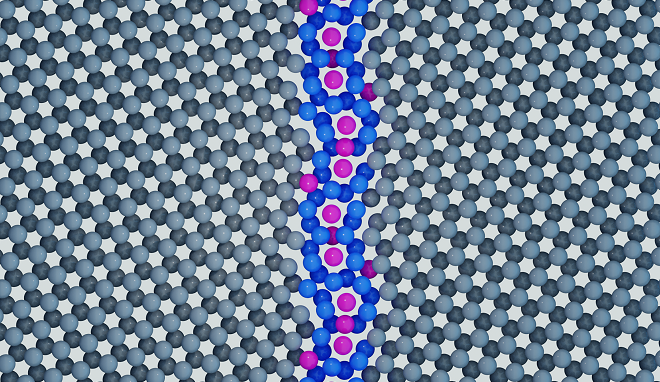
Quasicrystalline-like grain boundary phase
Most technologically relevant materials are polycrystalline in nature, and their internal interfaces significantly affect their properties and functionality. The interfaces separating differently oriented crystals, known as grain boundaries (GBs), strongly impact the durability and overall performance of materials. Tailoring the properties of polycrystalline materials by designing the structure and composition of GBs has recently emerged as a promising pathway. Beyond being considered simple two-dimensional (2D) interfaces, it has been realized that GBs themselves can adopt distinct 2D states [1-3]. Transitions between different GB phases can be triggered by various factors, including the segregation of solutes in multi-component systems. This segregation can profoundly influence materials, ranging from causing embrittlement to providing beneficial strengthening. However, an understanding of how solutes affect the interface structure and hence GB phase transitions is lacking.
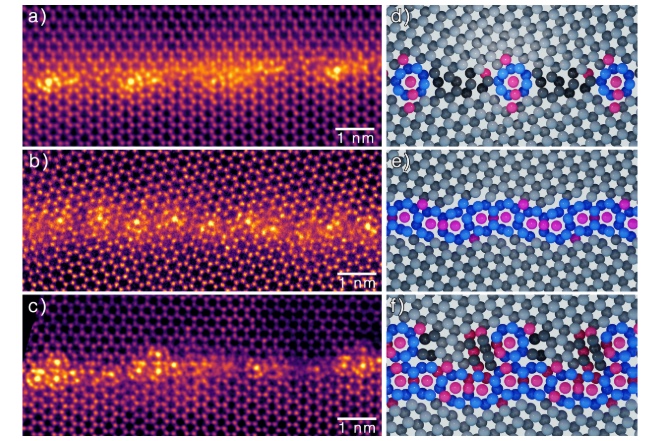
Here, we used atomic-resolution imaging and atomistic simulations to observe how iron (Fe) segregation alters the structure of GBs in hexagonal close-packed (hcp) titanium (Ti) [4]. Atomic resolution high-angle annular dark field (HAADF)–scanning transmission electron microscopy (STEM) of a pristine Σ13 [0001] symmetric tilt GB in Ti revealed a distinct periodicity with subunits “A,” “B,” and “C” [4]. These units are similar to those modeled in Ti and other ceramic-based materials. Observing a GB segment decorated with Fe at atomic resolution demonstrated a complete rearrangement of the atoms from the “ABC” configuration to isolated cage-like units in an asymmetric GB as shown in Figure 1a. The elemental contrast provided by HAADF-STEM imaging suggested that the cage center is rich in Fe, whereas the surrounding shell is rich in Ti. This observation was verified using near-atomic resolution energy-dispersive X-ray and electron energy loss spectroscopy in the STEM [4]. However, the intensity of the central Fe-rich columns is higher than expected for a fully occupied Ti column, indicating that a restructuring of the GB core also occurred along the viewing direction. At other interfaces, we even observed that cages form a layer-of-cages (Figure 1b) and that cages assemble to form aperiodic clusters (Figure 1c).
We used advanced atomistic modeling to predict the 3D structure of the icosahedral cage units and to explore the underlying nature of the segregation-induced phase transformations. Grand canonical GB structure prediction as a function of Fe composition at 0 K revealed more than five distinct GB structures. Similar to experiment, isolated cages (Figure 1d), a layer-of-cages (Figure 1e), cage clusters (Figure 1f) and even more complex cage arrangements were found [4]. These findings are supported by hybrid molecular dynamics and Monte Carlo simulations in the canonical ensemble at 300 K, where it is observed that different GB phases, represented by different cage arrangements, can transform into each other by increasing the amount of Fe in the system. With this, the total amount of Fe that can be adsorbed at the GB upon cage formation is more than twice as high compared to the pristine Ti GB structure.
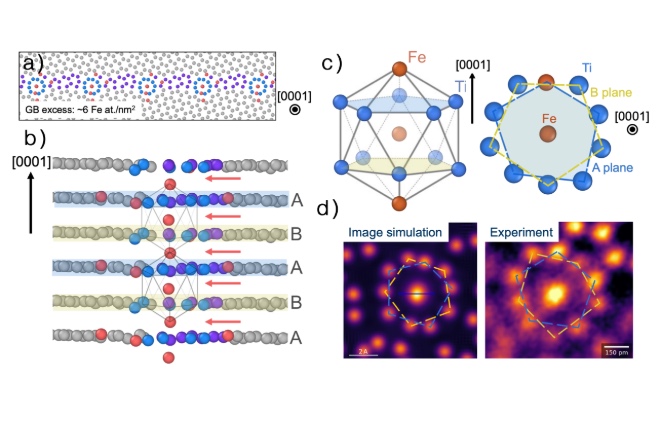
The simulations provide access to the three-dimensional view of the cages as shown in Figure 2. The view perpendicular to the tilt axis of the GB shows that the cage units observed in the experiment are composed of icosahedra. They are stacked on top of each other to form a chain of icosahedrons along the tilt axis, where the Fe atoms in the central column occupy interstitial positions between the (0002) lattice planes of the hexagonal close-packed structure (Figure 2b and d). The topological properties of these icosahedral cages, described by their symmetry, dense atomic packing, and geometric flexibility, enable them to adapt to the given bicrystallography and promote the formation of several distinct GB phases characterized by different numbers of clustered icosahedral cage structures. However, their fivefold symmetry and triangulated surface net of atoms prevent them from growing into bulk phases (Figure 2c). The results show how the formation of icosahedral phases can induce new states of GBs reminiscent of glass-like or quasicrystalline structures.
Understanding the nature of phase transitions of GBs in metallic alloys induced by solute atoms is pivotal to GB structure engineering and to sculpt new materials with advanced properties. The formation of icosahedral cage structures leads to a complete restructuring of the interface. The cage units act as building blocks of distinct GB phases, explaining why more than twice the amount of Fe can be incorporated compared to the solubility limit of the initial GB. The observed topological segregation transition provides insights into solute-induced states of GBs and introduces another lever for interface design.
References
[1] Hart E. W., Scripta Metallurgica (1968).
[2] Meiners T., et al., Nature (2020), 579, 375-378.
[3] Langenohl L., et al., Nature Communications (2022), 13, 3331.
[4] Devulapalli V., et al., Science (2024), 386, 420-424.