- Ruhr-Universität Bochum
Thermal spray as a powerful coating technology for different energy system
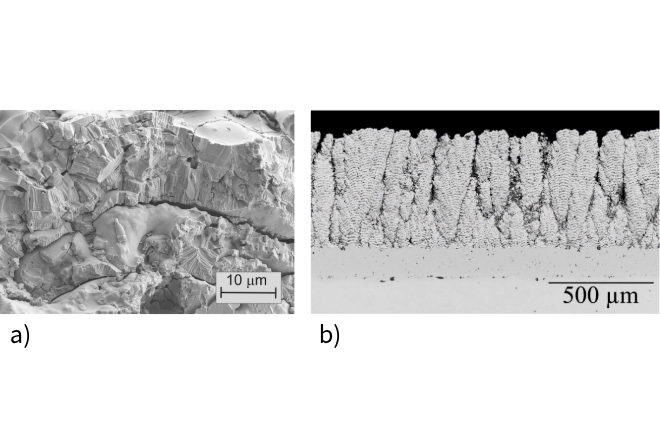
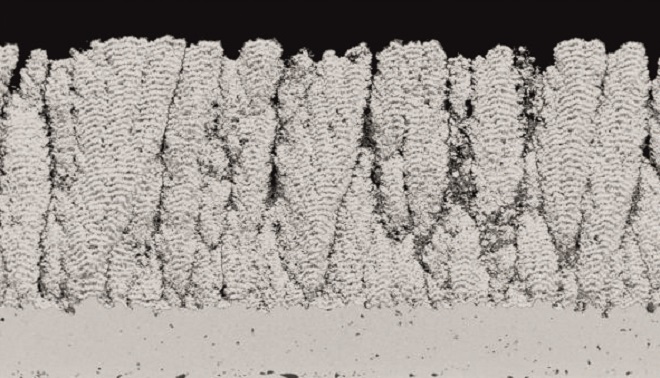
Thermal spray is a coating technology which is used in numerous applications for the deposition of rather thick ceramic or metallic coatings. In this process, powderous feedstocks in the size range of several 10 micrometers are accelerated and heated in a hot and fast gas jet. When the particles impinge on the substrate, they produce a lamellar structure. Ceramic coatings are often full of microcracks and pores due to the fast cooling after deposition and the brittle nature of the feedstock. These microstructural features are often beneficial for high temperature applications e. g. as thermal barrier coatings (TBCs) in gas turbines as they reduce effectively stress levels during thermal cycling. Figure 1a shows the fracture surface of an atmospherically plasma sprayed (APS) yttria stabilized zirconia (YSZ) thermal barrier coating (TBCs) with cracks within and between the sprayed lamella. This strain tolerant microstructure can be even further improved by implementing columnar structures in the coatings (Figure 1b). The gaps between the columns can open during heating of a component leading to a strain-tolerant coating. Such coatings can be produced by suspension plasma spraying (SPS) in which suspensions are introduced in the plasma jet instead of particles. As the droplet size is then much lower, the droplets can now follow the gas flow of the jet only impinging on surface obstacles where the columns grow. We could demonstrate that the full use of such coating systems can only be made, if a peroxidation of the underlying bond coat is made before coating deposition [1]. Such coatings have then a more than twofold better thermal cyclic performance as conventional APS coatings.
Also SiC/SiC composites as advanced structural materials for high temperature applications need protective coatings when being used in gas turbines. Here the water vapor corrosion plays an important role as it leads to evaporation of the typically on SiC formed silica scale and hence the corrosion of the hole component. This degradation can be significantly reduced by different coatings e. g. made of Yb2Si2O7. This so-called environmental barrier coatings (EBCs) are also mainly applied by atmospheric plasma spraying. Major issues are here the micro-cracked and hence not gas-tight as well as amorphous microstructure of the APS coatings. Crystallisation at high temperatures leads to shrinkage and crack formation. Here we could demonstrate that with very low pressure plasma spraying (VLPPS) dense and crystalline coatings can be produced [2].
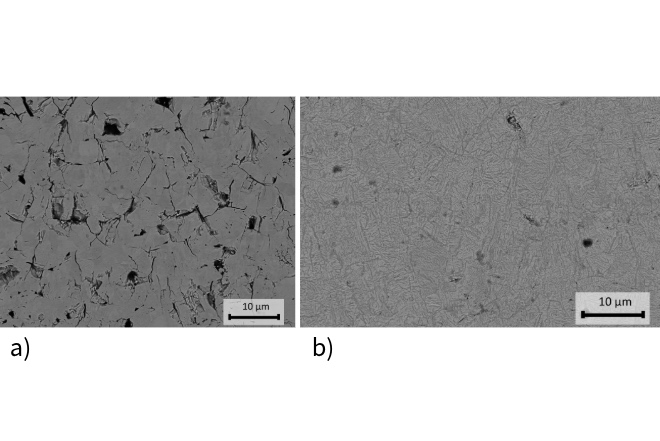
A self-healing chrome evaporation barrier which is used to prevent Chrome poisoning in solid oxide fuel cells (SOFCs) can be made of a MnCoFe oxide spinel. It is often deposited by APS which leads to a microcracked, porous coating. The Cobalt is reduced during spraying and so a simple rock salt structure is formed. During operation in air above 500°C the structure takes up again the oxygen. The accompanied volume expansion closes the cracks in the coatings and leads to an extremely protective coating (Figure 2)[3].
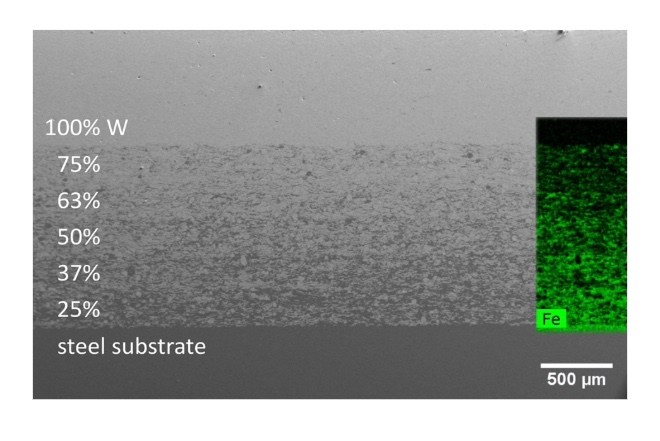
In addition to the shown ceramic coatings also metallic coatings can be produced by thermal spray. As first example in Figure 3 a graded tungsten/ferritic steel coating is shown. This type of coating is a candidate for the first wall of a fusion reactor. The gradient helps to compensate the large mismatch between the thermal expansion coefficients of the structural material made of ferritic steel and the plasma facing tungsten [4]. A favourable way to produce this structure is by vacuum plasma spraying. Although the in-plane stress in the top layer is hardly affected, the thickness of the deformed layer at the interface is enlarged and so the damage is no longer localized. This concept can also be transferred to real components and was 2022 awarded with the SOFT Innovation Prize by the European Commission [5].
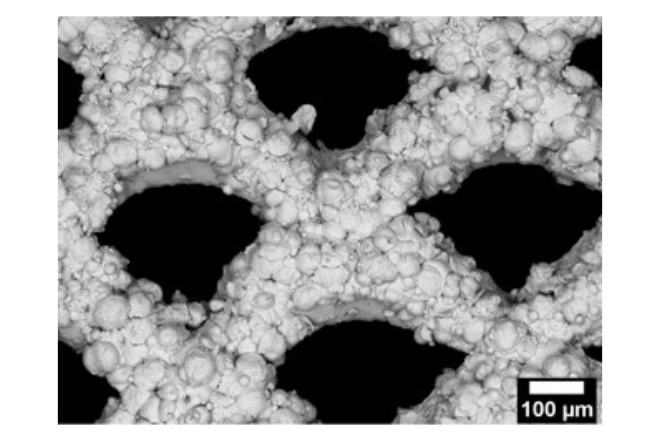
Another important field of application for thermally sprayed coatings is the water electrolysis. We could demonstrate within the HyInnoCells project in the Zukunftscluster Wasserstoff at RWTH Aachen that in PEM electrolysis cold sprayed titanium coatings on stainless steel expanded metal could substitute porous transport layer (PTL) completely made out of titanium and hence reducing the titanium consumption [6]. In the now started HyInnoLyze2 project this is further developed and in addition newly identified, extremely corrosion resistant alloys – a patent was just filed – will be further improved. Here also combinatorial approaches using PVD technology to manufacture large amounts of different compounds will be used to screen and optimize corrosion properties. Finally, it could be demonstrated that thermal spray can be used for the manufacture of complete cells for alkaline electrolysis, this will be in depth investigated in the BMWK project Kadise.
References:
[1] Joeris J., et al., Coatings (2023), 13 (9).
[2] Vassen R., et al., Coatings (2019), 9 (12).
[3] Grünwald N., et al., Journal of the European Ceramic Society (2019), 39 (2), 449-460.
[4] Grammes T., et al., Fusion Engineering and Design (2023), 188, 113430.
[5] https://research-and-innovation.ec.europa.eu/news/all-research-and-innovation-news/soft-innovation-prize-three-researchers-awarded-2022-09-19_en.
[6] Sievert T., et al., Surface and Coatings Technology, submitted.